Last updated: November 23, 2026
Quick Answer: Planning and ideation work best as one loop, not two separate tasks, and this guide gives you the 5-step version. Planning and ideation are the two halves of early-stage decision making. In this Planning and Ideation guide, planning sets the target, limits, and next step; ideation fills the empty space with options worth testing. The mistake most teams make is starting with ideas before the problem is clear, or locking the plan too early and killing better options.
Key takeaways
- Planning answers what matters, by when, and under what limits.
- Ideation answers what could work, what could fail, and what is worth trying first.
- A faster path can be better framing, not more brainstorming.
- A good idea is not the one that sounds clever. It is the one that fits the goal, the audience, and the constraints.
- The main trade-off is speed versus clarity: move too fast and the plan is weak; stay in ideation too long and nothing ships.
What is planning and ideation?
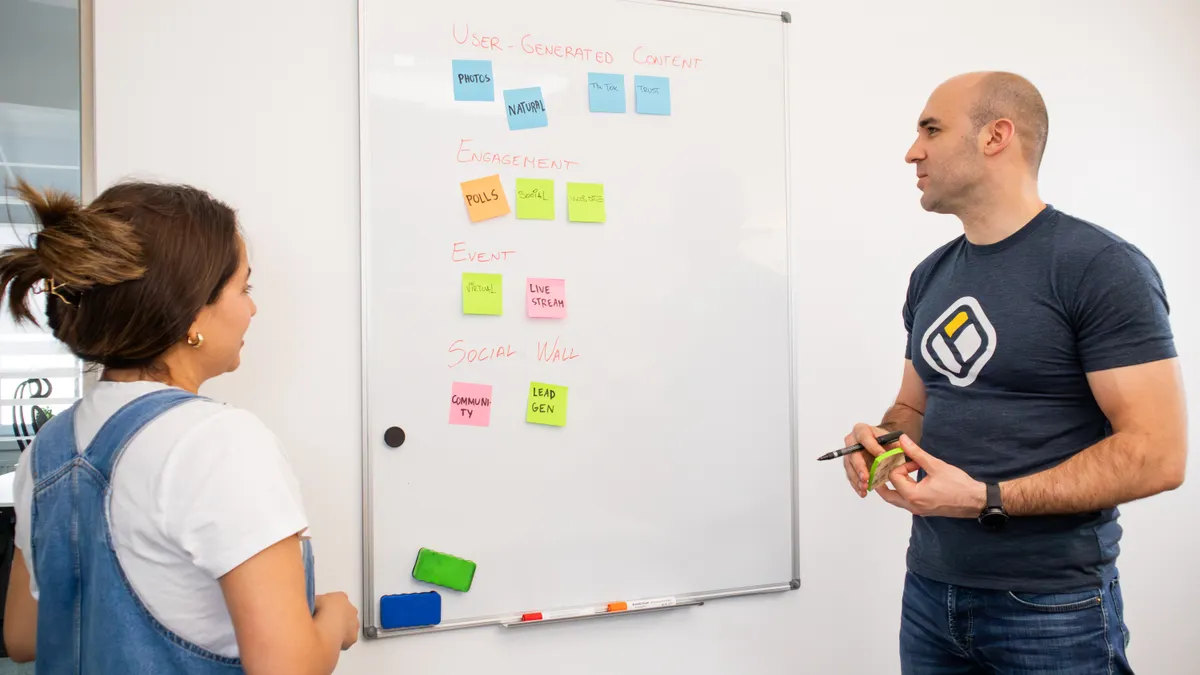
Planning and ideation are the two halves of early-stage decision making. Planning decides the problem, the goal, the constraints, and the order of work; ideation produces possible answers before time and budget close the door.
A simple way to think about it is this: planning reduces confusion, and ideation creates options. The process is often described in design thinking and product work, including standards such as ISO 56002 for innovation management and methods like the 5-day design sprint popularized by Google Ventures. The labels vary, but the job stays the same: turn a vague need into a direction people can act on.
According to the Stanford d.school, the mistake is treating ideation as a free-for-all; if you are unsure how to frame the problem, consult a design, product, or research professional before you lock the brief. Without a plan, brainstorming turns into a pile of nice-sounding ideas with no filter. Without ideation, planning becomes a spreadsheet for a path nobody has questioned. For a practical overview of the loop, see also the related pages on planning process, ideation techniques, and design thinking.
Why does planning have to come before ideation?
Planning has to come first because ideation without a frame produces too many weak choices. If the goal, user, deadline, or budget is unclear, the team spends energy inventing ideas for a problem that has not been pinned down.
That does not mean the plan must be perfect before any idea appears. It means the first planning pass should answer four things: what outcome is wanted, who it is for, what is off-limits, and what success looks like. In product and service work, those four answers often matter more than a long list of concepts.
A good early plan is short enough to revisit. A long plan can slow the team before the real work starts. The risk on the other side is just as real: endless ideation with no scope wastes time and makes decisions harder, not easier.
How do I set the problem up before brainstorming?

Set the problem up by writing one clear problem statement, one target user, and one constraint set before any idea session. That single page is the filter that keeps the session useful.
A strong problem statement names the pain, the person, and the expected change. For example, “Increase first-time completion of a signup flow for mobile users who stop at the verification step” is more useful than “Improve onboarding.” It gives ideation a lane. It also tells the group what not to solve.
The setup should also include the boundaries. Deadlines, legal rules, brand limits, technical limits, and budget limits all belong on the page. If the team skips those, it will later have to reject half the ideas for reasons that should have been visible from the start.
For a deeper framework, the Stanford d.school’s design thinking materials and the Nielsen Norman Group’s guidance on user-centered design are both useful references:
- Stanford d.school: https://dschool.stanford.edu/
- Nielsen Norman Group: https://www.nngroup.com/
- Google Ventures design sprint: https://www.thesprintbook.com/
What makes ideation useful instead of noisy?
Ideation becomes useful when it produces distinct options, not just more words. The goal is not to fill a whiteboard; the goal is to create candidates that can be compared on fit, cost, and risk.
A useful session has a time box, a clear prompt, and a rule that forces variety. One round can ask for the safest fix, another for the cheapest fix, and another for the most ambitious fix. That keeps the group from circling the same idea in different clothes. The point is not volume alone; it is range.
A weak ideation session usually fails in one of two ways. Either the group jumps to the first familiar answer, or it chases novelty that looks clever but cannot survive the constraints. Both are expensive mistakes because they feel productive in the room.
Planning vs. ideation: what is the real difference?
Planning chooses the lane; ideation chooses the vehicles. That is the cleanest difference, and it matters because the two steps solve different problems.
| Criteria | Planning | Ideation | Winner for this condition |
|---|---|---|---|
| Main goal | Define the work | Generate possible answers | Planning, when the problem is still fuzzy |
| Output | Scope, goals, constraints, sequence | Concepts, approaches, variations | Ideation, when the target is already clear |
| Best use of time | Before action starts | Before selection starts | Planning for alignment; ideation for choice |
| Main risk | Over-control or vague scope | Too many weak ideas | Planning if the team lacks direction |
| Best group size | Small, decision-focused | Small to medium, idea-rich | Planning for decisions; ideation for breadth |
| Typical question | “What are we trying to solve?” | “What could solve it?” | Planning for framing; ideation for options |
| Failure mode | A plan with no workable ideas | Ideas with no decision rule | Planning if the team keeps drifting |
| Good end point | A usable brief or roadmap | A shortlist ready for review | Ideation when options need testing |
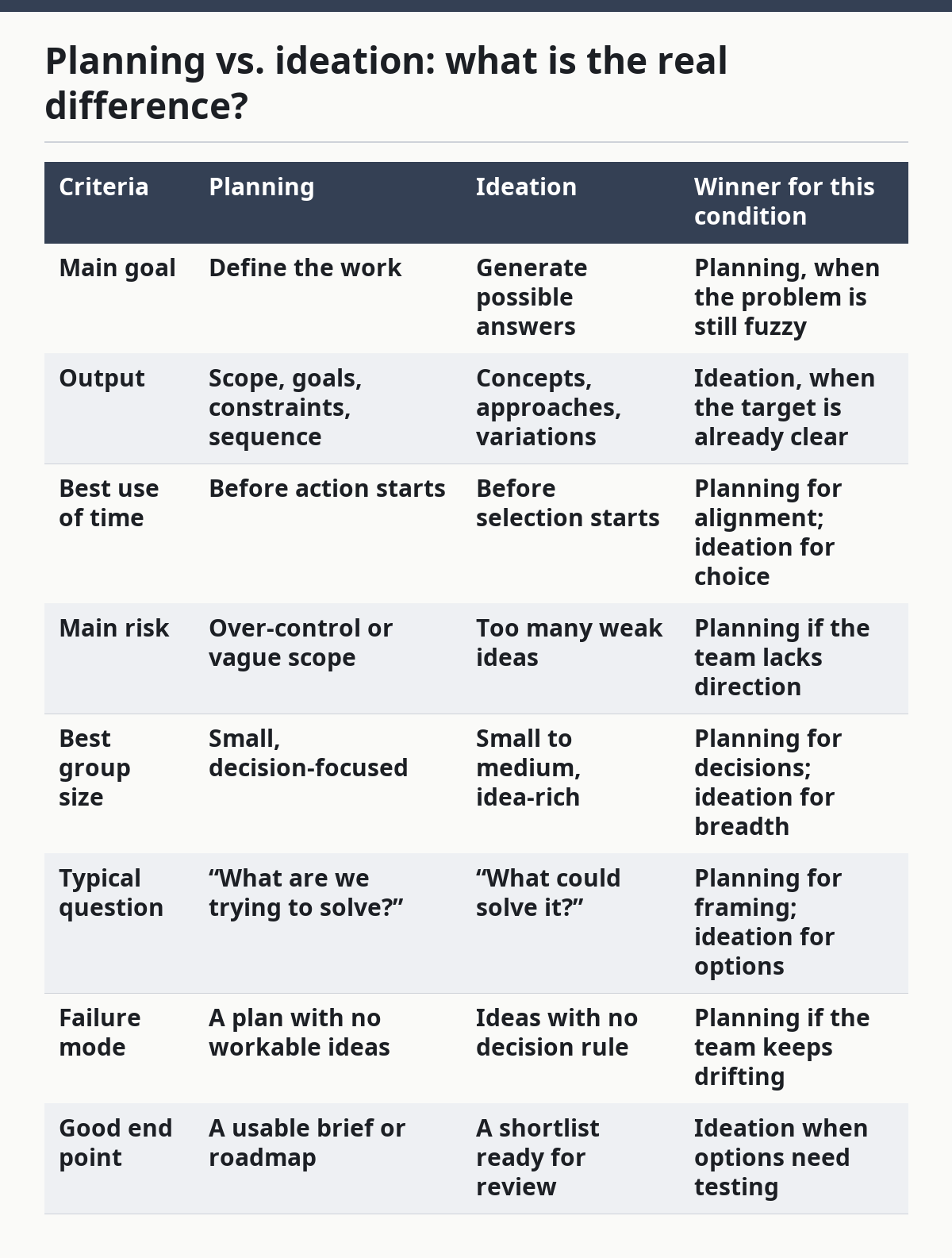
Planning wins when the team needs alignment. Ideation wins when the team already knows the problem and needs better choices. The wrong move is to ask ideation to do planning’s job, because that makes the session feel creative while solving nothing. For related comparisons, see workshop facilitation and product discovery.
Which planning method fits which kind of work?
The right planning method depends on how much uncertainty sits in the problem. Simple work needs a short brief; complex work needs a more careful sequence.
For straightforward tasks, a one-page plan can be enough. It should state the outcome, the audience, the deadline, and the first step. For higher-risk work, a longer planning method helps, such as a phased roadmap, a user journey map, or a design sprint structure. Google Ventures’ 5-day sprint is useful when a team needs to compress thinking into a short window and leave with something testable.
| Method | Best for | Strength | Weakness | Who should skip it |
|---|---|---|---|---|
| One-page brief | Small, clear projects | Fast and easy to update | Can miss hidden risks | Teams handling legal, technical, or cross-team complexity |
| Roadmap | Multi-step work | Shows sequence and dependencies | Can become rigid | Teams that need fast iteration |
| Design sprint | Problems that need a fast prototype path | Forces focus in a short window | Requires disciplined facilitation | Teams that are not ready to make decisions in days |
| User journey map | Experience-heavy work | Reveals friction points | Can take time to build well | Teams with no user evidence yet |
| Brainstorming session | Idea generation | Produces many options fast | Can create noise without rules | Teams that want a final answer in one meeting |
The honest trade-off is this: the more complex the work, the more planning structure it needs. The more obvious the problem, the less ceremony is useful. A heavy framework on a small task wastes energy. For a practical next step, link this Planning and Ideation process to project roadmap and user journey mapping.
How do I turn ideas into a real plan?
Turn ideas into a real plan by scoring them against the same 3 to 5 criteria, then choosing the one that best fits the goal and limits. Without a shared filter, the loudest idea often wins, which is a bad way to make a decision.
A practical filter is fit, cost, speed, risk, and proof. Fit asks whether the idea solves the stated problem. Cost asks what it would take to build or run. Speed asks how fast it can be started. Risk asks what could break. Proof asks what evidence would show it is working.
The result should be a short action plan, not a philosophy document. Name the first task, the owner, the due date, and the decision point. If the idea cannot survive that step, it is not ready for the plan. It may still be a good thought, but it is not yet a plan.
When should the whole approach change?
The whole approach should change when the problem is still unclear after one planning pass, when ideas keep collapsing under the same constraint, or when no one can agree on what success means. Those are signs that the issue is not ideation quality; it is problem definition.
Three exception scenarios matter here. First, if the work is highly regulated, planning has to lead much more strongly than ideation because the space for change is smaller. Second, if the team is stuck in a creative rut, a stricter ideation method can help, such as a timed round with one rule per round. Third, if the team already knows the answer from prior evidence, there is no need for a long ideation cycle; a direct plan is better.
A final warning: if every session ends with “we need more ideas,” the real issue is not lack of creativity. It is usually a missing decision rule or a vague goal.
What are the most common mistakes?
The most common mistake is confusing activity with progress. A stack of sticky notes, a long meeting, or a polished slide deck can all look productive while producing nothing usable.
Another mistake is skipping constraints because they feel negative. Constraints are not the enemy of good ideas; they are what make ideas real. A concept that ignores budget, time, or user behavior is not bold. It is unfinished.
A third mistake is choosing ideas by taste. “I like it” is not a useful standard when the job is to solve a specific problem. The better question is whether the idea fits the brief, reduces risk, and can be tested with the least waste. For evidence-based guidance, see the Nielsen Norman Group and the U.S. Small Business Administration’s planning resources at https://www.sba.gov/.
FAQ
What comes first, planning or ideation?
Planning comes first, because ideation needs a target. If the problem is still vague, the ideas will be vague too. A short planning pass that names the goal, user, and constraints gives the ideation stage a real job.
How many ideas should a session produce?
A session should produce enough ideas to create real choice, not a fixed magic number. The point is to get several different approaches, including at least one safe option and one more ambitious option. If every idea looks the same, the session is not broad enough.
Is brainstorming the same as ideation?
Brainstorming is one ideation method, but ideation is broader. Ideation includes sketching, prompt-based thinking, reverse thinking, and structured variation, not just open discussion. A brainstorming-only process can be too loose for harder problems.
What is the biggest sign that planning was weak?
The biggest sign is when good ideas keep getting rejected for reasons that should have been clear earlier. If budget, timing, or user needs appear late in the process, the planning stage was too thin. That usually means the team solved the wrong version of the problem first.
Can planning be too detailed?
Yes. Planning becomes a drag when it tries to predict every move before the first real test. A useful plan sets direction and limits, then leaves room for revision after evidence appears. The balance matters more than the page count.
Drafted with AI; not yet reviewed by a person.