Last updated: November 13, 2026
Quick Answer: How to Write Better Drafts: A Practical Framework for Stronger Drafts: related questions usually gets clearer when you use a repeatable 6-step process: define the job, choose one reader, outline before prose, draft fast, revise in passes, and edit for cuts. The notes below settle what to do first, what to skip, and when a draft is actually getting better.
Key Takeaways
- Better writing starts before the first sentence. If the point is fuzzy, the draft will wobble.
- One reader is easier to write for than a crowd. Narrowing the audience sharpens tone, detail, and examples.
- Drafting and revising are different jobs. Mixing them slows everything down.
- Strong drafts usually get shorter before they get better. Cuts often fix more than additions.
- If a section can’t be explained in one sentence, it probably needs a tighter claim.
What actually makes a draft stronger?
A stronger draft says one thing clearly, in the order a reader needs it, and leaves out the parts that only make the writer feel busy. If your page has a clear point, a clean structure, and fewer stray sentences, the draft is already moving in the right direction.
How to Write Better Drafts: A Practical Framework for Stronger Drafts: related questions starts here, because the job is to make the draft easier to read, not just easier to write. Picture this: you’ve got a messy page, a blinking cursor, and three ideas fighting for space. The fix is not “write more.” It’s choose one main job for the draft, then build every paragraph around that job.
Here’s the catch: most weak drafts fail for the same 3 reasons.
- The point changes halfway through.
- The reader has to guess what matters.
- The writer keeps revising sentences before the structure works.
If you want better drafts, start with the answer you want the reader to leave with. Then ask what belongs on the page to support that answer—and what does not.
A useful check is plain enough:
- If the draft can be summarized in one sentence, it has a center.
- If each paragraph pushes that same center forward, it has shape.
- If you need a 2-minute explanation to make the point make sense, the draft is not ready yet.
Quick check: if you can’t say what the draft is for in one sentence, stop writing and fix that first.
How do I start if the draft feels too messy?
Start by writing the job of the draft at the top of the page in one plain sentence, then build an outline that matches it. If the draft is messy, the problem is usually not speed—it’s that the page has no map.
Because the page has no map yet, the next step is a short sort, not a full rewrite. Picture this: you’re staring at notes, screenshots, half-finished lines, and a rough idea. A 10-minute sort is often enough to see what belongs where.
-
Write the draft’s job in one sentence.
- Example shape: “This draft explains X so the reader can do Y.”
- If you can’t write that, the draft is still a topic list, not a draft.
-
Pick one reader.
- A beginner needs background and examples.
- An experienced reader needs the differences, the edge cases, and the shortcut.
- A mixed audience usually gets watered-down copy.
-
List the 3–5 points that must appear.
- Put the easiest-to-understand point first.
- Move supporting detail under each point, not beside it.
-
Cut anything that does not serve the job.
- If a paragraph does not change the reader’s understanding, it probably belongs in a note, not the draft.
- A draft with a few strong parts beats a long draft with many weak ones.
-
Decide the order.
- Most readers need the answer first.
- Then they need the “how.”
- Then they need the exception.
-
Draft section by section.
- Finish one section before moving on.
- Don’t let yourself keep circling the opening line.
The truth is, a rough outline is often enough. If the structure is right, the prose can be plain. If the structure is wrong, even polished sentences feel off.
A simple benchmark helps here: if the outline can fit on one screen, it’s probably tight enough to draft from. If it needs pages of notes, it may still be a pile of ideas.
Quick check: if you keep rewriting the first paragraph, you probably need a better outline, not a better opening line.
How do I know what to cut?
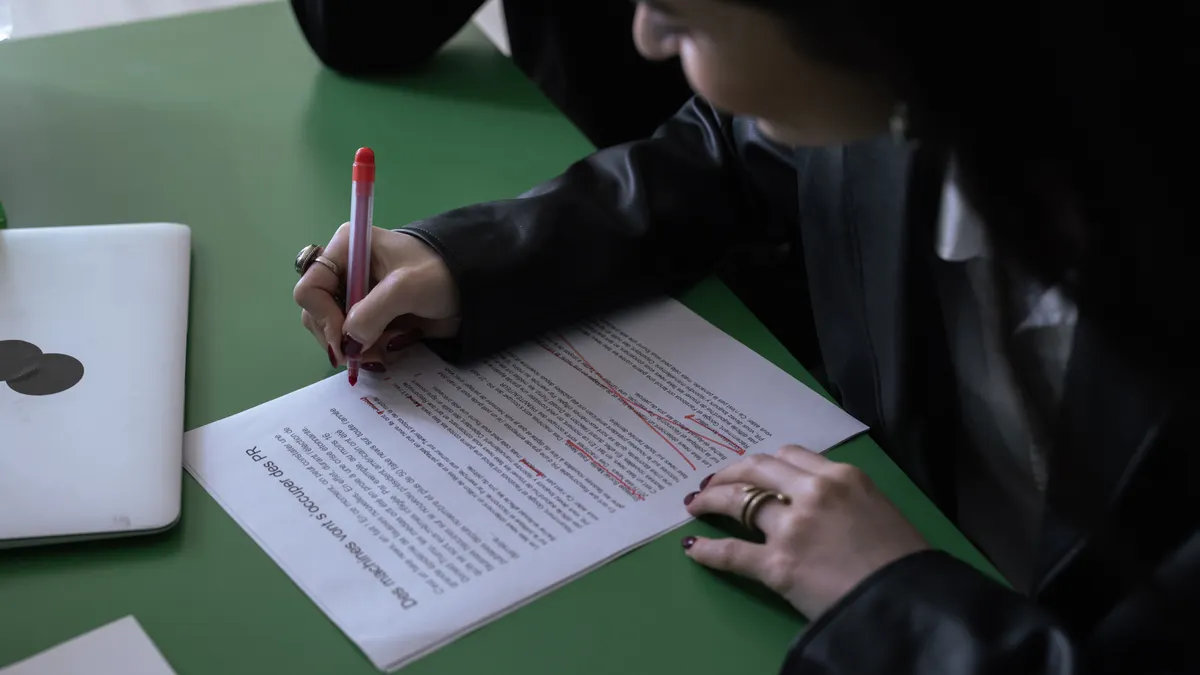
Cut anything that does not help the reader decide, understand, or act within 30 seconds of reading it. Strong drafts are shaped by subtraction, not just addition.
Because extra content usually hides the real message, the cut pass matters as much as the first draft. Picture this: you’ve got a draft with useful facts, but it still feels heavy. The usual problem is not missing content—it’s extra content standing in the way. The reader does not need every thought you had.
Here’s a practical rule: if a sentence repeats a point already made, cut it. If a paragraph adds background but no new decision-making value, cut it. If an example is interesting but not necessary, move it or remove it.
| Situation | Best Path | Why Other Options Fail |
|---|---|---|
| The draft is too long | Remove repeated points, then shorten examples | Trimming random lines leaves the real clutter in place |
| The draft feels vague | Replace abstract claims with a concrete example or specific step | More adjectives do not fix a weak point |
| The draft feels slow | Put the main answer earlier and move setup lower | Long lead-ins make readers leave before the payoff |
| The draft feels scattered | Merge similar sections into one clear path | Separate sections can split the reader’s attention |
If you want a sharper draft, use this cut pass:
- Highlight every sentence that repeats another sentence’s job.
- Delete one of each repeated pair.
- Find any paragraph that starts with a broad claim and never narrows down.
- Replace vague words like “good,” “better,” or “effective” with a measurable sign or a visible result.
- Read the draft out loud and mark any line that sounds like filler.
A concrete test works well: if you removed a paragraph and the draft still makes sense, that paragraph was likely doing too little. Not every omission is a loss.
Quick check: if the draft would be better with 20% less text, you’ve probably got the right target.
How do I revise without making the draft worse?
Revise in passes, one problem at a time, or you’ll turn the draft into a patchwork of small fixes. Drafting asks for momentum; revision asks for control.
Because revision works best in layers, each pass should have one job. Picture this: you’ve got something on the page, and now every sentence looks possible, optional, or wrong. That’s normal. The mistake is trying to fix clarity, style, logic, and grammar all in one sweep.
Use this order instead:
-
Pass 1: structure
- Check whether the sections are in the right order.
- Move or merge anything that interrupts the main path.
- If the reader has to jump around, fix that before touching prose.
-
Pass 2: meaning
- Make every paragraph say one clear thing.
- If a paragraph has two jobs, split it.
- If it has no job, cut it.
-
Pass 3: line-level clarity
- Replace fuzzy verbs with specific ones.
- Swap long phrases for shorter ones where the meaning stays the same.
- Kill hidden clutter like “in order to,” “due to the fact that,” and “at this point in time.”
-
Pass 4: rhythm
- Vary sentence length.
- Put short sentences after long ones when you want the point to land.
- Keep the page moving.
-
Pass 5: final proof
- Check spelling, punctuation, and missed words.
- Read headings by themselves to see whether they still tell the story.
- Make sure the first sentence under each heading answers the heading directly.
A good revision pass changes only one layer. If you start fixing everything at once, you’ll lose track of what improved and what got worse.
The best part is that you can stop earlier than you think. Once the structure is clear, the claims are tight, and the lines are clean, more editing often gives you less—not more.
Quick check: if you can name the one thing you’re fixing on this pass, you’re revising well.
When does the standard advice fail?
The standard advice fails when the reader, the draft type, or the deadline changes the job. In those cases, “just write more clearly” is too vague to help.
Because format changes the work, the next step depends on what the draft is for. Picture this: you’re working on a piece that is not a normal essay. It might be a memo, a landing page, a help article, or a draft under a hard deadline. Each one changes what “better” means.
-
If the reader is busy, lead with the answer.
- What changes: they won’t read a slow buildup.
- What to do instead: put the conclusion, recommendation, or main point in the first 2–3 sentences.
-
If the topic is technical, define only what the reader needs.
- What changes: too much explanation can bury the action.
- What to do instead: define terms only where they matter, then move on.
-
If the draft is persuasive, order matters more than flair.
- What changes: the reader needs reasons in a logical sequence.
- What to do instead: start with the strongest reason, then the second, then the risk or limit.
-
If the draft is for scanning, use signposts.
- What changes: the reader may never read every line.
- What to do instead: use short headings, plain labels, and one idea per paragraph.
-
If the deadline is tight, simplify the shape.
- What changes: there’s no room for perfect polish.
- What to do instead: write the simplest version that answers the question clearly, then stop.
A few things do not work well in any of these cases. Fancy openers, long transitions, and vague endings usually waste the reader’s time. A draft can look polished and still be hard to use.
Quick check: if the draft has a special audience or format, the “normal” advice may be too slow or too broad.
What tools and benchmarks help most?
The tools that help most are the ones that show problems fast: an outline, a voice memo, a read-aloud pass, and a plain checklist. You do not need a large toolkit to write better; you need a reliable one.
Because the goal is fast diagnosis, simple tools beat elaborate ones. Picture this: you’ve got the draft on screen and you want a fast way to tell whether it works. The useful tools here are simple, and most are already on your device.
- Outline first: use headings or bullet points before drafting full paragraphs.
- Read aloud: awkward rhythm shows up fast when you hear it.
- Search for repeats: find repeated phrases, repeated claims, and repeated examples.
- Use a style guide: if your work has one, follow it for spelling, punctuation, and headings.
- Set a length target: if the draft is supposed to be 800 words or 1,500 words, check whether the draft matches the assignment.
A few benchmarks help more than opinions:
- One clear main point per section.
- First sentence under each heading answers the heading directly.
- No paragraph that needs the reader to guess its purpose.
- Fewer words with the same meaning is usually a win.
- Any sentence that confuses the reader once should be rewritten immediately.
For source-backed writing, the right standards can also help. The Chicago Manual of Style and the AP Stylebook both exist to reduce noise and keep writing consistent. For accessibility-minded digital writing, guidance from the W3C Web Content Accessibility Guidelines is worth knowing because clear structure helps more than decoration.
That’s the point: tools are there to reveal weakness, not to add polish for its own sake.
Quick check: if a tool doesn’t help you spot a real problem in under a minute, it’s probably not the right tool for the draft.
Which habits make better writing stick?
Small habits make better writing stick because they reduce the number of choices you have to make on every page. A repeatable process beats a burst of motivation.
Because habits lower friction, they make the next draft easier to start. Picture this: you want the next draft to be easier than the last one, not just different. That takes habits you can repeat on a Tuesday afternoon, not heroic effort.
Try this sequence:
- Start with one sentence that states the job of the piece.
- Draft the outline before you draft the prose.
- Write the rough version without stopping to polish every line.
- Take a break before revision.
- Revise in passes, not at random.
- Read the headings as if you were a new visitor.
- Cut one sentence for every new sentence that doesn’t add value.
A useful habit is to save especially strong lines and structures in a simple note. Not as a crutch—as a reference. If a lead, transition, or ending works once, there’s no reason to reinvent it from zero every time.
The truth is, better writing is usually better judgment. The more often you ask, “Does this help the reader now?” the stronger the draft gets.
Quick check: if your process changes from piece to piece, the results will too.
How do I know the draft is ready?
The draft is ready when a new reader can follow it without help and the main point lands on the first pass. If you still need to explain the structure aloud, it’s not ready yet.
Because the final check is about reader experience, not writer effort, this stage should stay simple. Picture this: you’re almost done, but the page still feels slightly off. That last stage is less about beauty and more about checking whether the draft does its job cleanly.
Use this final check:
- Can the reader say what the piece is about after the first paragraph?
- Does each heading lead to a real answer?
- Are any sections repeating the same point in different words?
- Can a reader skim the headings and still understand the path?
- Did you leave in any sentence only because it sounded nice?
A simple stop rule helps here: if you have fixed structure, logic, and clarity, stop. Endless polish can flatten a draft that already works.
Quick check: if the draft answers the question without your help, it’s ready to ship.
What if I still feel stuck?
If you’re still stuck, the draft is probably asking for one more decision, not one more sentence. Go back to the job, the reader, and the outline, because one of those is still unclear.
Drafted with AI; not yet reviewed by a person.